
More hair f
 or sure, but don't ya think there's a connection there? Plus as my sister said when I showed her this vid, "Hey, is that Gimli son of Gloin on the bagpipe?" It's a gaida actually, but her point is well taken. One of their other videos is pretty much just a closeup of the hurdy the whole time! Eluvate's most recent disc, Slania, is actually a pretty interesting concept piece. Many of the lyrics are in Gaulish, and detail the history and battle of the Helvetica tribe of the Gauls. If you know your Roman history, the Helveticae were a people basically anihilated by Julius Caesar just to make a name for himself before returning to Rome to take over. And to think I missed them when they played in St. Paul on the Paganfest tour this spring!! Aaargh!
The heavy drone thing is baked to perfection in the Polish "bio-techno" grou
 p Village Kollektiv, which yes, does share a few members with Warsaw Village Band. The Kollektiv is the hurdy gurdy/throat singing/jaw harp/Bulgarian vocal harmonies/techno beats and samples cousin of Village Band, however. Close your eyes and listen to "Blow Wind Blow" on their MySpace page. I let a pan burn on the stove in the other room the first time I heard that track, just standing there lost in my living room, ears and brain open wide. I searched the web over for a decent vid of Village Kollektiv and they are all pretty low-fi, but here is one from an outdoor festival earlier this year, and you can see Maciej Cierlinski there in back with his hurdy. (That name will resurface later in this post.) Anyway, can't wait until their new disc comes out; Motion Roots Experimental was one of my top recordings of 2007.
Or how about the Polish "Psychodelic Proto-Slavonic Music" of Zywiolak.
Tell me that's not influenced by some of the same Nordic bands. Oh, why look! Hurdy Gurdy Project is their first MySpace friend!
which was an earlier project of Zywiolak's Robert Jaworski. Apparently he's also an alum of an early version of Warsaw Village Band.
So I set out in search of the ancient Hedningarna connection in the most modern way; I sent a MySpace message with a few questions to Robert Jaworski. After a few week's delay because he had to travel to Germany to see Hedningarna in concert (aha!) he sent me back this great message about how he got into playing the hurdy and where he is heading with this music. It also gives an insight into Polish folk music.. who knew they were all into the Celtic thing? Polish Catholicism clamping down on the mythology and folklore more than Nordic Lutheranism?

Here's what he has to say (with a tiny bit of editing to tidy up his past tense verbs.)
Basically, how did you get into playing the hurdy?
That's not easy question.. ( :
It's better to answer how did I find this instrument?
Few years ago I was typical happy "folky boy" from small town looking for something unusual in music ...
I was fascinated in sea songs which were very popular at young people fire-parties in Poland. I finded that most of tunes singing by the people around fire are Polish versions of Irish and English folk songs...
So I started to listen "Celtic folk music"..
In Poland it's almost like a fashion in some groups of young people...
Most of young musician don't dig in our folk culture.. It's easier to find Irish than Polish folk tunes in the internet..
True is that "Warsaw Village Band" proved to young people that we have something interesting in our Polish folk music too..
But.. I found Polish hurdy gurdy at "Celtic Music Festival" in Poland..
It was my friend Maciej Cierlinski performing with Polish band called "Slainte".. They played some of most popular Celtic melodies with Spanish gaita and something really strange with the crank outside...
It was Polish hurdy gurdy.. The sound of this instrument was so raw..(the pickup he used was very easy thing)... It was totally different from sweety spanish gaita playing to the microphone... The other way was that both of them played totally similar bordun music whiche was so cool and I loved this sound...[I'm guessing "bordun" like drone? The Swedish word for drone is similar. -M.E.]
After the concert Maciek show me his Polish - (not high quality) hurdy gurdy..
I loved this "cheap instrument sound".. My rock'n'roll soul told me that it is the instrument I was really looking for..
There is no the ending of this story... Some time after I bought almost the same model from the same folk luthier.. And I have played this instrument since that day..
Who are the influences?
That's really good question now..
Some time before I started to play with "Warsaw Village Band" I found one thing which changed my thinking about music.. It was recordings of Scandinawian modern folk bands.
Hedningarna, Garmarna, Hoven Droven etc .
It was something totally fable(y?) in comparing to our Polish folk music stage. The other way is our Catholic Polish system removed us from our reach Slavonic mythology. And I think that is the main reason why the young people of Poland are not interested in playing and creating new Polish folk music. Our folk art is beautiful but quite boring the same way. Most of the lyrics refer to polish religiousness or something.
Those Scandinawian bands showed that playing folk music not means playing and singing only village melodies ... They just use their heritage.. That's a big difference between Polish and Scandinavian folk music..
The other way are similarity between Polish and Scandinavian music...
Most of tunes playing by Hedningarna or other mostly Swedish bands are "Polska tunes" - traditional Swedish melodies..
They come from the time of the “Swedish Deluge” of Poland, and are related to Polish violin music of the time.. Of course most of them are totally new but the character is still the same..
So it's not so hard to find similarity in aranging of new melodies.
I'm really happy I can draw from Nordic music which is "southic" the same way ( ; .
I think my band called "Żywiołak" is good example to understand those things..
Where did you get your hurdy?
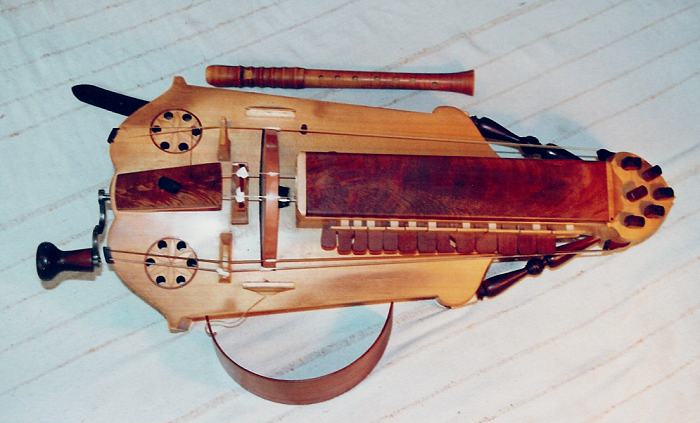
As I told I ordered it from folk luthier of south-east part of Poland - Mr.Stanisław Wyżykowski and it is totally "raw folk work"..
I 've made plenty of modification in quite similar way like Totte Mattsson's hurdy gurdy from Hedningarna..
Meeting with him inspired me so much. If I could only say I had any teacher in my profession I would say this is Totte...
Why the rocking' primal sound rather than than something more traditional?
"rocking primal sound"? - it sounds really funny.. ( :
The answer is very busy..
Cos I'm a rock'n'roller first but I also really love Polish tradition.. (;
So I set out in search of the ancient Hedningarna connection in the most modern way; I sent a MySpace message with a few questions to Robert Jaworski. After a few week's delay because he had to travel to Germany to see Hedningarna in concert (aha!) he sent me back this great message about how he got into playing the hurdy and where he is heading with this music. It also gives an insight into Polish folk music.. who knew they were all into the Celtic thing? Polish Catholicism clamping down on the mythology and folklore more than Nordic Lutheranism?

The man and his hurdy
Here's what he has to say (with a tiny bit of editing to tidy up his past tense verbs.)
Basically, how did you get into playing the hurdy?
That's not easy question.. ( :
It's better to answer how did I find this instrument?
Few years ago I was typical happy "folky boy" from small town looking for something unusual in music ...
I was fascinated in sea songs which were very popular at young people fire-parties in Poland. I finded that most of tunes singing by the people around fire are Polish versions of Irish and English folk songs...
So I started to listen "Celtic folk music"..
In Poland it's almost like a fashion in some groups of young people...
Most of young musician don't dig in our folk culture.. It's easier to find Irish than Polish folk tunes in the internet..
True is that "Warsaw Village Band" proved to young people that we have something interesting in our Polish folk music too..
But.. I found Polish hurdy gurdy at "Celtic Music Festival" in Poland..
It was my friend Maciej Cierlinski performing with Polish band called "Slainte".. They played some of most popular Celtic melodies with Spanish gaita and something really strange with the crank outside...
It was Polish hurdy gurdy.. The sound of this instrument was so raw..(the pickup he used was very easy thing)... It was totally different from sweety spanish gaita playing to the microphone... The other way was that both of them played totally similar bordun music whiche was so cool and I loved this sound...[I'm guessing "bordun" like drone? The Swedish word for drone is similar. -M.E.]
After the concert Maciek show me his Polish - (not high quality) hurdy gurdy..
I loved this "cheap instrument sound".. My rock'n'roll soul told me that it is the instrument I was really looking for..
There is no the ending of this story... Some time after I bought almost the same model from the same folk luthier.. And I have played this instrument since that day..
Who are the influences?
That's really good question now..
Some time before I started to play with "Warsaw Village Band" I found one thing which changed my thinking about music.. It was recordings of Scandinawian modern folk bands.
Hedningarna, Garmarna, Hoven Droven etc .
It was something totally fable(y?) in comparing to our Polish folk music stage. The other way is our Catholic Polish system removed us from our reach Slavonic mythology. And I think that is the main reason why the young people of Poland are not interested in playing and creating new Polish folk music. Our folk art is beautiful but quite boring the same way. Most of the lyrics refer to polish religiousness or something.
Those Scandinawian bands showed that playing folk music not means playing and singing only village melodies ... They just use their heritage.. That's a big difference between Polish and Scandinavian folk music..
The other way are similarity between Polish and Scandinavian music...
Most of tunes playing by Hedningarna or other mostly Swedish bands are "Polska tunes" - traditional Swedish melodies..
They come from the time of the “Swedish Deluge” of Poland, and are related to Polish violin music of the time.. Of course most of them are totally new but the character is still the same..
So it's not so hard to find similarity in aranging of new melodies.
I'm really happy I can draw from Nordic music which is "southic" the same way ( ; .
I think my band called "Żywiołak" is good example to understand those things..
Where did you get your hurdy?
As I told I ordered it from folk luthier of south-east part of Poland - Mr.Stanisław Wyżykowski and it is totally "raw folk work"..
I 've made plenty of modification in quite similar way like Totte Mattsson's hurdy gurdy from Hedningarna..
Meeting with him inspired me so much. If I could only say I had any teacher in my profession I would say this is Totte...
Why the rocking' primal sound rather than than something more traditional?
"rocking primal sound"? - it sounds really funny.. ( :
The answer is very busy..
Cos I'm a rock'n'roller first but I also really love Polish tradition.. (;
YEAH! Wow! Thank you so much Robert and I hope we get to see one of your projects at the Cedar someday.




 Posts

